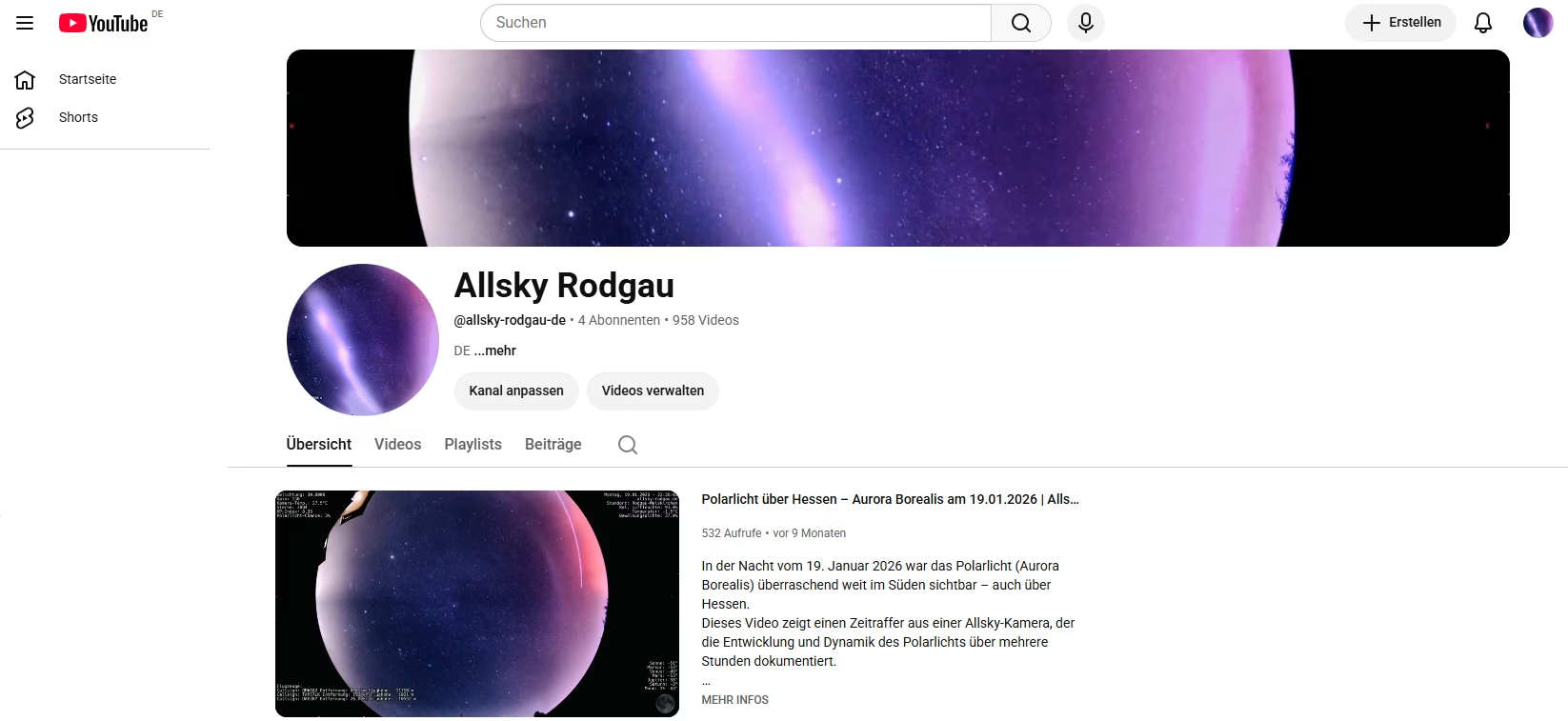
 indi-allsky has a native YouTube interface that I’ve been tweaking quite extensively over the past few weeks. You can now find all the time-lapse videos from my Allsky camera on YouTube as well. What was initially intended primarily as an additional archive has since become a fairly extensive collection of the sky over Rodgau-Weiskirchen—featuring daytime and nighttime footage, star trails, monthly films, and a wealth of background information on each clip—from the probability of seeing the aurora to the average number of visible stars.
You can find the channel here: Open the allsky-rodgau.de YouTube channel
…and you can read here about what awaits you there!
Daytime Time-Lapse: Clouds, Weather, and Light
The daytime videos show the camera’s entire daily cycle in time-lapse. You’ll see cloud movements, weather changes, contrails, airplanes, and, of course, the progression of light from morning to evening.
The description includes the recording date and the calculated camera window. I deliberately omit irrelevant nighttime data—such as star counts, the Kp index, or the probability of auroras—from daytime videos. During the day, stars are rarely the main focus. 😉
Nighttime Time-Lapse: A Complete Night in Just a Few Minutes
Each night video summarizes a full night of camera footage. Depending on the weather and season, you’ll see stars, moonlight, clouds, satellites, airplanes, planets, and sometimes even special celestial events like the aurora.
The title itself already contains some key information. A title like
11/03/26 | Kp2.7 MaJS | All-Sky Timelapse | Night Sky over Hesse | allsky-rodgau.de | night
first specifies the date and the highest NOAA Kp value for that night. The abbreviations that follow stand for planets that were geometrically well-positioned above the horizon during the calculated time period—in this example, Ma for Mars, J for Jupiter, and S for Saturn.
This explicitly does not mean that all the planets listed must actually be visible in the video. Clouds, buildings, trees, and the actual brightness of the sky are not taken into account in this geometric calculation.
How does it all work?
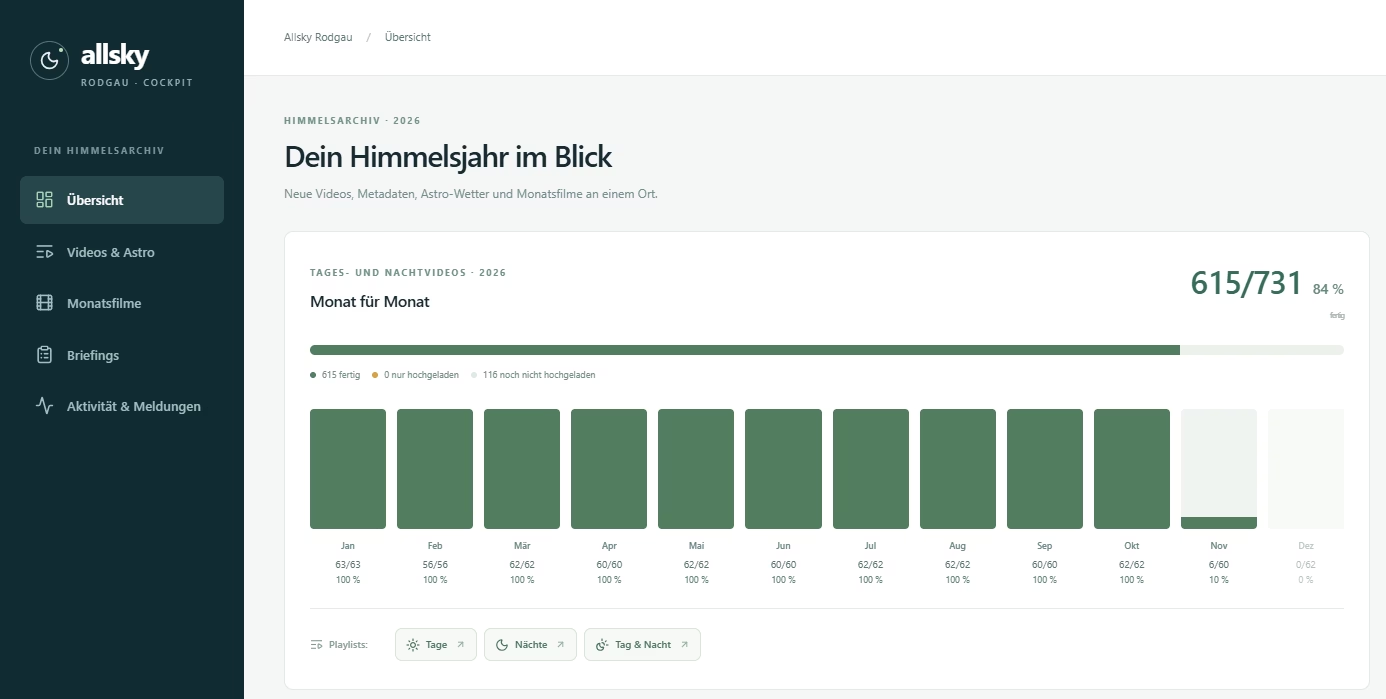 Technically, I implemented the entire process using a combination of indi-allsky, the YouTube API, and some of my own AI automations. indi-allsky generates the daytime, nighttime, and star-trail time-lapse videos and handles the actual upload. The videos are then automatically recognized, uniquely assigned to their respective recordings, and supplemented with the appropriate titles, German and English descriptions, as well as the corresponding measurement and calculation values. Afterward, they are placed in the correct playlists, published, and—in the case of night videos and star trails—linked to one another. The monthly films are compiled from the individual recordings of a given month and are then also automatically tagged with chapters, descriptions, and the six corresponding annual playlists. A small custom dashboard keeps track of which steps have actually been completed and where something is still missing.
A pretty cool side effect: my Astrowetter overview list
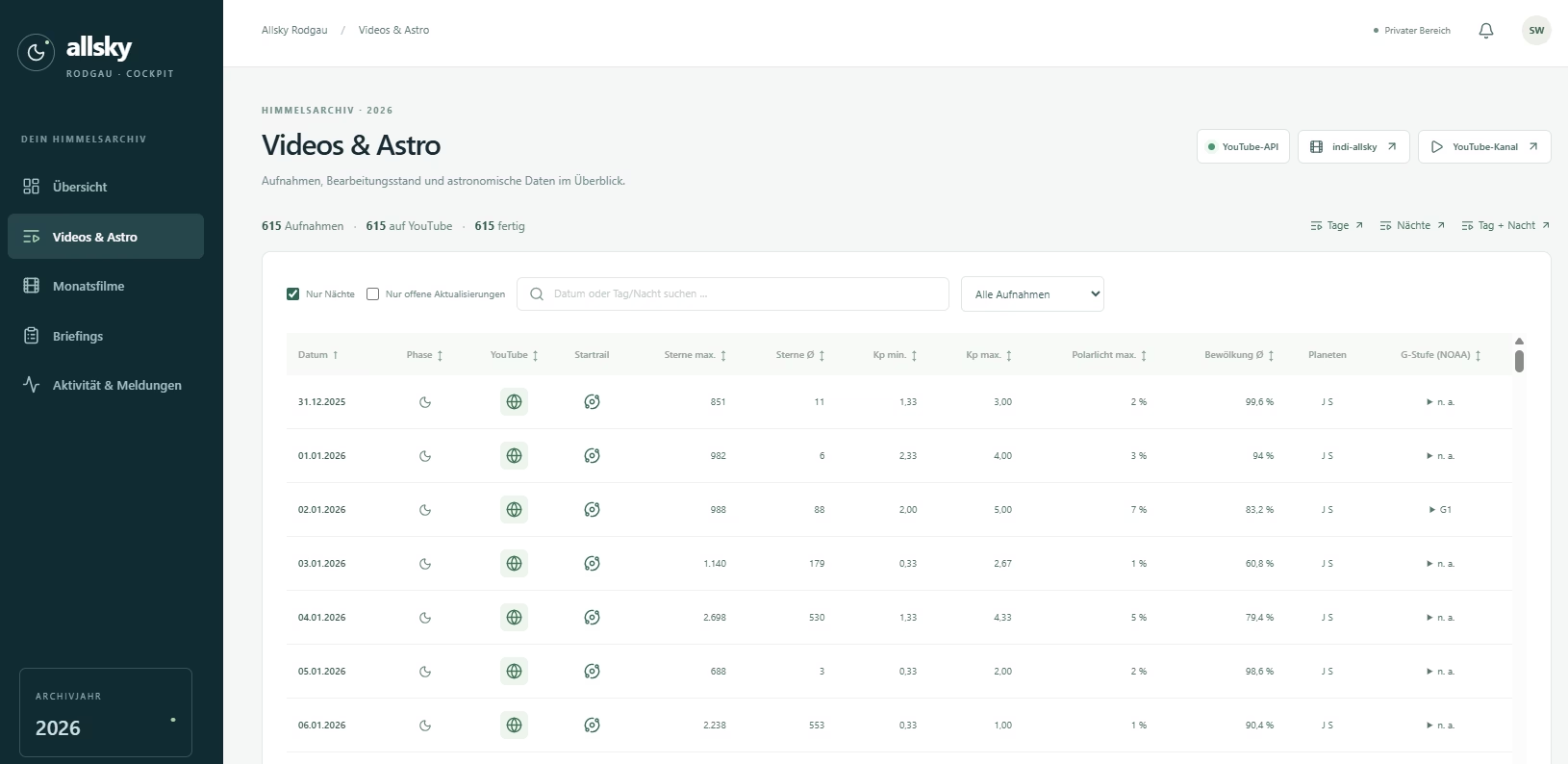 As part of the development process, I’ve continued to expand the dashboard and have also created my own archive of astronomical conditions for each recorded night. This archive consolidates, among other things, the minimum and maximum NOAA Kp values, average and maximum star counts, the stored aurora probability, maximum moon illumination, the modeled average cloud cover, and favorably positioned planets with time windows and maximum altitude. Added to this are the corresponding geomagnetic observation alerts from NOAA—clearly separated from mere forecasts. This allows you not only to view the respective video retroactively but also to understand the conditions under which the recording was made.
What exactly is included in the video descriptions?
The descriptions of the nighttime videos are intentionally quite detailed. They include—in both German and English—the following, among other things:
- the exact date of recording
- the calculated camera field of view for Rodgau-Weiskirchen
- the maximum and average number of automatically detected stars per individual recording
- the highest NOAA Kp value for the overlapping three-hour intervals
- the aurora probability stored by indi-allsky
- the maximum recorded moonlight
- Time windows and maximum altitudes of favorably positioned planets
- original geomagnetic observation alerts from NOAA, if available
- the data sources used and notes on the limitations of the calculation
Important to note: The Kp value describes global geomagnetic activity and is not a local measurement taken over Rodgau. Furthermore, an aurora forecast does not constitute proof that the aurora was actually visible above the camera. I try to clearly highlight such differences in the descriptions.
Startrails: When Earth’s rotation becomes visible
For nights with enough usable individual frames, indi-allsky also creates a startrail time-lapse. In this, the apparent movements of the stars caused by the Earth’s rotation become visible as circular trails.
The star counts provided are derived from the individual frames taken that same night—not from an automatic count of the final star trails.
The night time-lapse and the corresponding startrail are linked to each other. So if you spot an interesting segment in a night video, you can go directly to the corresponding startrail—and from there back to the complete night.
If a star trail could not be generated due to thick cloud cover or a lack of suitable images, there is of course no corresponding video for that night. Nothing is artificially filled in.
Monthly Films: An Entire Month in One Go
In addition to the individual day and night videos, there are monthly films. They compile all the footage from a calendar month into longer films.
Six versions are created for each month:
- Days – German
- Days – English
- Nights – German
- Nights – English
- Day and Night Combined – German
- Day and night combined – English
Chapter markers take you directly to the individual days or nights. For the night chapters, the average and maximum star ratings as well as the respective maximum Kp value are also listed. The chapters for the daytime videos are intentionally kept simpler and list only the date and time of day.
In short: If you don’t want to click through more than 60 individual videos, you can watch an entire month in one go—either just during the day, just at night, or as a combination of both.
The Most Important Playlists
To help you navigate the now quite extensive archive, the videos are sorted chronologically into separate playlists:
The monthly films also have six separate annual playlists:
- Monthly Films – Days – German
- Monthly Timelapses – Days – English
- Monthly Timelapses – Nights – German
- Monthly Timelapses – Nights – English
- Monthly Timelapses – Day and Night – German
- Monthly Timelapses – Day and Night – English
Website for the current sky, YouTube for the archive
You can still find the current image and the latest recordings directly at allsky-rodgau.de or on the page with live images from Rodgau-Weiskirchen.
The YouTube channel, on the other hand, serves as the long-term video archive: to go back to a specific date, compare different nights, or simply relax and watch an entire month’s worth of footage.
If you’re interested, feel free to check it out and subscribe to the channel:
That’s it—have fun browsing!