For my Allsky project, I rely on a powerful camera unit—originally the Raspberry Pi High Quality Camera with M12 mount, but now replaced by the significantly more sensitive ZWO ASI678MC—combined with a DHT22 sensor for reliable temperature and humidity measurement. This combination provides robust sky images and, at the same time, precise climate data, which is essential for stable operation under changing weather conditions.
1st Raspberry Pi HQ Camera
(UPDATE: It turned out to be the ZWO ASI678MC!)
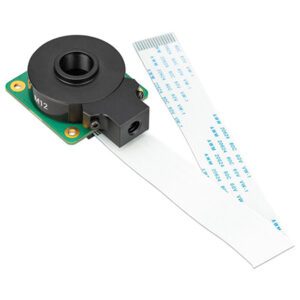
The Raspberry Pi High Quality Camera is an advanced camera for Raspberry Pi projects that offers high image quality and flexibility. With a 12.3 megapixel sensor and the ability to use different lenses, it is suitable for a wide range of applications, from professional photography to scientific experiments. It can cope well with environmental conditions such as temperature fluctuations and humidity, making it ideal for an all-sky camera that also has to withstand wind and weather.
A major advantage of the M12 mount version is the ability to use a wide range of M12 lenses, which are available in many sizes and focal lengths – and are also sometimes available at super low prices. A “cheap” fisheye lens can be purchased directly from China for as little as 10 euros.
An appropriate cable is required to connect the High Quality Camera. This will connect the 15 pin FPC connector (1.0mm pitch) on the camera to the 22 pin FPC connector (0.5mm pitch) on your Raspberry Pi.
2nd DHT22 sensor
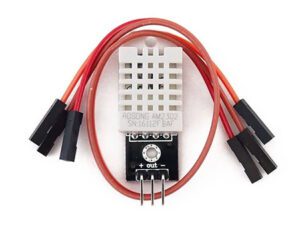 The DHT22/AM2302 is an ideal sensor for my Allsky project as it provides precise temperature and humidity values in real time. Compared to its predecessor, the DHT11, the DHT22 offers higher accuracy and an extended measurement range, making it particularly suitable for applications that take place outdoors. The sensor can measure temperatures from -40 to +80 °C and humidity from 0 to 100 % (relative humidity) and transmits the data digitally to a microcontroller, which enables stable and interference-free data transmission. These features are crucial for my project as accurate and reliable climate data helps to continuously monitor the environmental conditions around my Allsky camera and react to changes in the weather if necessary. I use a version with a breakout board with an integrated resistor that can be connected directly to the Raspberry Pi 5.
I explain here how to set up the sensor – and how to deal with the error message “Python modules not installed” on the Raspberry Pi 5 !