Since I have connected my Allsky camera to my router via Ethernet cable, I don’t need Bluetooth or Wifi on my Raspberry Pi 5. Both can be permanently deactivated with two lines.
And this is how it works:
Since I have connected my Allsky camera to my router via Ethernet cable, I don’t need Bluetooth or Wifi on my Raspberry Pi 5. Both can be permanently deactivated with two lines.
And this is how it works:
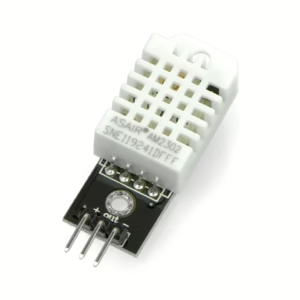 Installing the DHT22 sensor took me quite a bit of research. First, I had to find out exactly how to wire the sensor to the Raspberry Pi 5 – but then the problems really started, as I received the error message “Python modules not installed” in the indi-allsky software. Here I’ll show you how to wire the DHT22 and get rid of the error message in indi-allsky!
At some point during the installation of my Allsky system, I decided to start again for various reasons. To do this, I removed the micro SD card, loaded a new image and put the micro SD card back into the Raspberry Pi 5. During the next boot, an error message appeared with the information “WARNING: REMOTE HOST IDENTIFICATION HAS CHANGED!”. Seems dramatic at first, but is quickly explained and easily fixed!
Since I have only found a few complete instructions, I will describe here step by step the installation of the indi-allsky software as I have done it. These instructions are aimed specifically at users of a Raspberry Pi and are based on the indi-allsky documentation. This is available on github in the corresponding repository. The instructions refer to the largely automatic process, how exactly the manual installation is carried out can be found in the indi-allsky wiki on github. For the Raspberry Pi 5, the automatic installation went smoothly.
 For an allsky camera, you need the corresponding software – the hardware alone may look more or less fancy, but it won’t do you any good at first. In the end, after a lot of research, I opted for indi-allsky, closely followed by allsky by Thomas Jacquin.
There are many software solutions that offer different functions – essentially…